e5f0613503b6973dbc886eba8e999f208d84853b net processing: Check if we are in ibd before processing block for txdownloadman (sedited)
ce8b692897f6aacbe936fe2220e85f23cd83cbf2 Add functional test exercising tx downloadman recently confirmed filter (Lőrinc)

Pull request description:

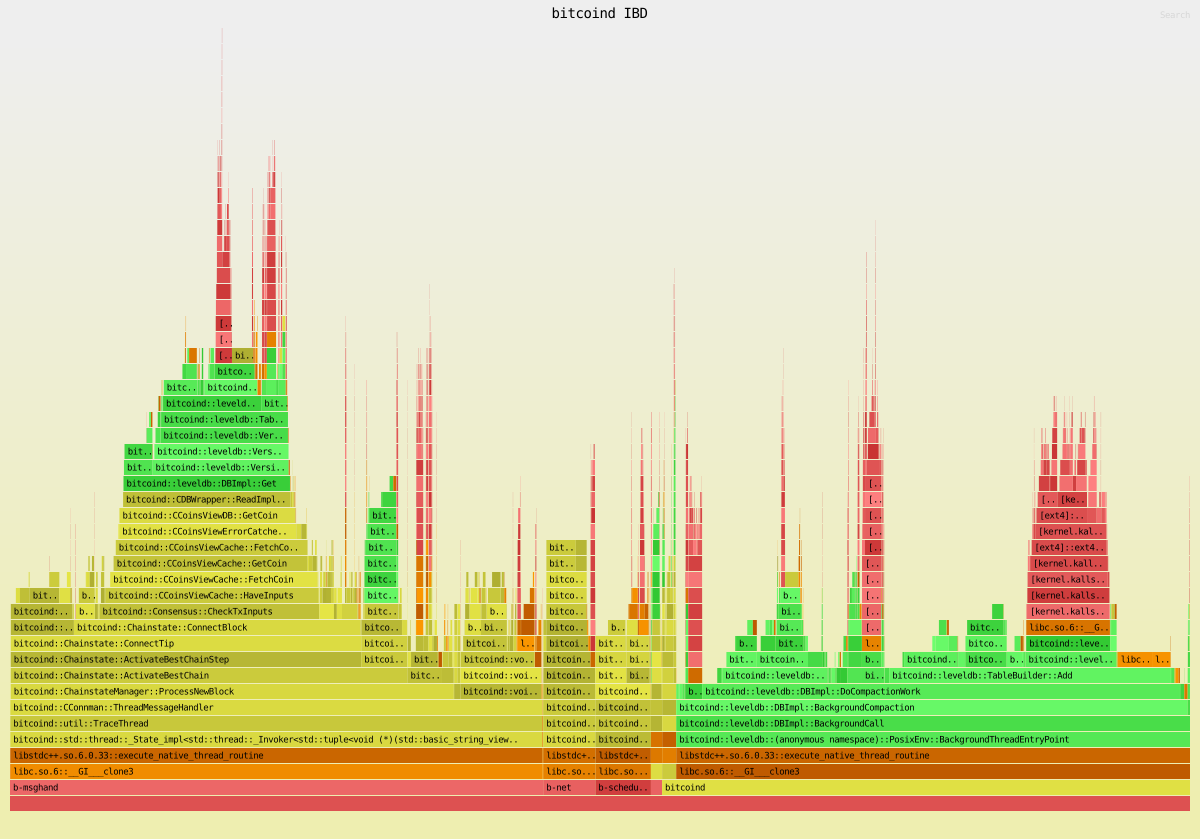
  Calculating the rolling bloom filters for the txorphanage takes some CPU time from the scheduler thread. This can be observed for example in [this flamegraph](https://bitcoin-dev-tools.github.io/benchcoin/results/pr-172/20066462508/mainnet-default-instrumented-base-flamegraph.svg?x=920203898521&y=780), where handling the filter takes about 2.6% of total time (and most of the scheduler thread's time).

  During ibd the entries in the tx download bloom filter are just continuously rolled over and aren't consumed, since no mempool entries are created by incoming transactions from peers during ibd. The mempool does accept transactions via RPC, or the wallet at the time, however these don't interact with the orphanage and the txdownloadman, because adding anything to those is guarded by IsInitialBlockDownload() checks as well.

  We're usually latching ibd to false a few blocks before catching up to the tip, so this should also not significantly degrade the performance of the filter once fully caught up.

ACKs for top commit:
  l0rinc:
    ACK e5f0613503b6973dbc886eba8e999f208d84853b
  instagibbs:
    ACK e5f0613503b6973dbc886eba8e999f208d84853b
  fjahr:
    Code review ACK e5f0613503b6973dbc886eba8e999f208d84853b

Tree-SHA512: d667e677f5723c438cdf5b34f0f9c1ade7cc1b2e98530c23f14384514daa38217c4e7c3b756194b6831b590a487449c4514b52bf0fb461ae8083061722824270
33fbaed310a6a37d41d26af8fb34308d088d72c8 policy: don't CheckEphemeralSpends on reorg (Greg Sanders)

Pull request description:

  Similar reasoning to https://github.com/bitcoin/bitcoin/pull/33504

  During a deeper reorg it's possible that a long sequence of dust-having transactions that are connected in a linear fashion. On reorg, this could cause each subsequent "generation" to be rejected. These rejected transactions may contain a large amount of competitive fees via normal means.

  PreCheck based `PreCheckEphemeralSpends` is left in place because we wouldn't have relayed them prior to the reorg.

ACKs for top commit:
  darosior:
    re-ACK 33fbaed310a
  ismaelsadeeq:
    reACK 33fbaed310a6a37d41d26af8fb34308d088d72c8
  sedited:
    ACK 33fbaed310a6a37d41d26af8fb34308d088d72c8

Tree-SHA512: cf0a6945066e9f5f8f9a847394c2c1225facf475a8aa4bc811b436513eff79c0a720d4ad21ba6b0f1cc4dfdd61cf46acb148333ac592b2ee252953732326ad1d
744d47fcee0d32a71154292699bfdecf954a6065 clusterlin: adopt trained cost model (feature) (Pieter Wuille)
4eefdfc5b7d0b86a523683de2a90da910b77a106 clusterlin: rescale costs (preparation) (Pieter Wuille)
ecc9a84f854e5b77dfc8876cf7c9b8d0f3de89d0 clusterlin: use 'cost' terminology instead of 'iters' (refactor) (Pieter Wuille)
9e7129df2962f7c52d07c14a56398bb285cac084 clusterlin: introduce CostModel class (preparation) (Pieter Wuille)

Pull request description:

  Part of #30289, replaces earlier #34138.

  This introduces a more accurate cost model for SFL, to control how much CPU time is spent inside the algorithm for clusters that cannot be linearized perfectly within a reasonable amount of time.

  The goal is having a metric for the amount of work performed, so that txmempool can impose limits on that work: a lower bound that is always performed (unless optimality is reached before that point, of course), and an upper bound to limit the latency and total CPU time spent on this. There are conflicting design goals here:
  * On the one hand, it seems ideal if this metric is closely correlated to actual CPU time, because otherwise the limits become inaccurate.
  * On the other hand, it seems a nightmare to have the metric be platform/system dependent, as it makes network-wide reasoning nearly impossible. It's expected that slower systems take longer to do the same thing; this holds for everything, and we don't need to compensate for this.

  There are multiple solutions to this:
  * One extreme is just measuring the time. This is very accurate, but extremely platform dependent, and also non-deterministic due to random scheduling/cache effects.
  * The other extreme is using a very abstract metric like counting how many times certain loops/function inside the algorithm run. That is what is implemented in master right now, just counting the sum of the numbers of transactions updated across all `UpdateChunks()` calls. It however necessarily fails to account for significant portions of runtime spent elsewhere, resulting in a rather wide range of "ns per cost" values.
  * This PR takes a middle ground, counting many function calls / branches / loops, with weights that were determined through benchmarking on an average on a number of systems.

  Specifically, the cost model was obtained by:
  * For a variety of machines:
    * Running a fixed collection of ~385000 clusters found through random generation and fuzzing, optimizing for difficulty of linearization.
      * Linearize each 1000-5000 times, with different random seeds. Sometimes without input linearization, sometimes with a bad one.
        * Gather cycle counts for each of the operations included in this cost model, broken down by their parameters.
    * Correct the data by subtracting the runtime of obtaining the cycle count.
    * Drop the 5% top and bottom samples from each cycle count dataset, and compute the average of the remaining samples.
    * For each operation, fit a least-squares linear function approximation through the samples.
  * Rescale all machine expressions to make their total time match, as we only care about relative cost of each operation.
  * Take the per-operation average of operation expressions across all machines, to construct expressions for an average machine.
  * Approximate the result with integer coefficients.

  The benchmarks were performed by `l0rinc <pap.lorinc@gmail.com>` and myself, on AMD Ryzen 5950X, AMD Ryzen 7995WX, AMD Ryzen 9980X, Apple M4 Max, Intel Core i5-12500H, Intel Core Ultra 7 155H, Intel N150 (Umbrel), Intel Core i7-7700, Intel Core i9-9900K, Intel Haswell (VPS, virtualized), Intel Xeon E5-2637, ARM Cortex-A76 (Raspberry Pi 5), ARM Cortex-A72 (Raspberry Pi 4).

  Based on final benchmarking, the "acceptable" iteration count (which is the minimum spent on every cluster) is to 75000 units, which corresponds to roughly 50 μs on Ryzen 5950X and similar modern desktop hardware.

ACKs for top commit:
  instagibbs:
    ACK 744d47fcee0d32a71154292699bfdecf954a6065
  murchandamus:
    reACK 744d47fcee0d32a71154292699bfdecf954a6065

Tree-SHA512: 5cb37a6bdd930389937c435f910410c3581e53ce609b9b594a8dc89601e6fca6e6e26216e961acfe9540581f889c14bf289b6a08438a2d7adafd696fc81ff517
3281824ecfa72c4f69ab69c94003b7f5a82c7265 fuzz: prevent invalid `FRESH` entries and surface `BatchWrite` errors (Lőrinc)
780f460635af86b91c4215e761b6895be762ed3e fuzz: avoid invalid `AddCoin` overwrites (Lőrinc)
d7e0d510f2bf2981e92e3b323aeba1c845377950 fuzz: make `AddCoins` query view for overwrites (Lőrinc)
b8fa6f0f701f04cffca6a085337b508381016649 util: introduce `TrySub` to prevent unsigned underflow (Lőrinc)
Pull request description:
### Problem
This is an alternative approach to #34647, fixes#34645.
### Fix
First, add `CheckedSub` and use it for decrements of `m_dirty_count` and `cachedCoinsUsage`, so unsigned underflows turn into immediate failures instead of silently wrapping and only failing later.
<details><summary>Assertion `j <= i' failed.</summary>
```bash
util/overflow.h:44 T CheckedSub(const T, const U) [T = unsigned long, U = bool]: Assertion `j <= i' failed.
==72817== ERROR: libFuzzer: deadly signal
#0 0x556e9225eab5 in __sanitizer_print_stack_trace (/mnt/my_storage/bitcoin/build_fuzz/bin/fuzz+0x191dab5) (BuildId: d77c4d5f9dfd38ea06fab463f49341735205e109)
#1 0x556e921acafc in fuzzer::PrintStackTrace() (/mnt/my_storage/bitcoin/build_fuzz/bin/fuzz+0x186bafc) (BuildId: d77c4d5f9dfd38ea06fab463f49341735205e109)
#2 0x556e92191bb7 in fuzzer::Fuzzer::CrashCallback() (/mnt/my_storage/bitcoin/build_fuzz/bin/fuzz+0x1850bb7) (BuildId: d77c4d5f9dfd38ea06fab463f49341735205e109)
#3 0x7164cfc458cf (/lib/x86_64-linux-gnu/libc.so.6+0x458cf) (BuildId: ae7440bbdce614e0e79280c3b2e45b1df44e639c)
#4 0x7164cfca49bb in __pthread_kill_implementation nptl/pthread_kill.c:43:17
#5 0x7164cfca49bb in __pthread_kill_internal nptl/pthread_kill.c:89:10
#6 0x7164cfca49bb in pthread_kill nptl/pthread_kill.c💯10
#7 0x7164cfc4579d in raise signal/../sysdeps/posix/raise.c:26:13
#8 0x7164cfc288cc in abort stdlib/abort.c:73:3
#9 0x556e92f9d591 in assertion_fail(std::source_location const&, std::basic_string_view<char, std::char_traits<char>>) /mnt/my_storage/bitcoin/src/util/check.cpp:41:5
#10 0x556e9250daf0 in bool&& inline_assertion_check<false, bool>(bool&&, std::source_location const&, std::basic_string_view<char, std::char_traits<char>>) /mnt/my_storage/bitcoin/src/util/check.h:90:13
#11 0x556e9250daf0 in unsigned long CheckedSub<unsigned long, bool>(unsigned long, bool) /mnt/my_storage/bitcoin/src/util/overflow.h:44:5
#12 0x556e9250daf0 in CoinsViewCacheCursor::NextAndMaybeErase(std::pair<COutPoint const, CCoinsCacheEntry>&) /mnt/my_storage/bitcoin/src/coins.h:282:25
#13 0x556e92507eb2 in (anonymous namespace)::MutationGuardCoinsViewCache::BatchWrite(CoinsViewCacheCursor&, uint256 const&) /mnt/my_storage/bitcoin/src/test/fuzz/coins_view.cpp:90:75
#14 0x556e92c17a2b in CCoinsViewCache::Flush(bool) /mnt/my_storage/bitcoin/src/coins.cpp:282:11
#15 0x556e924fb732 in TestCoinsView(FuzzedDataProvider&, CCoinsViewCache&, CCoinsView&, bool)::$_1::operator()() const /mnt/my_storage/bitcoin/src/test/fuzz/coins_view.cpp:135:34
#16 0x556e924fb732 in unsigned long CallOneOf<TestCoinsView(FuzzedDataProvider&, CCoinsViewCache&, CCoinsView&, bool)::$_0, TestCoinsView(FuzzedDataProvider&, CCoinsViewCache&, CCoinsView&, bool)::$_1, TestCoinsView(FuzzedDataProvider&, CCoinsViewCache&, CCoinsView&, bool)::$_2, TestCoinsView(FuzzedDataProvider&, CCoinsViewCache&, CCoinsView&, bool)::$_3, TestCoinsView(FuzzedDataProvider&, CCoinsViewCache&, CCoinsView&, bool)::$_4, TestCoinsView(FuzzedDataProvider&, CCoinsViewCache&, CCoinsView&, bool)::$_5, TestCoinsView(FuzzedDataProvider&, CCoinsViewCache&, CCoinsView&, bool)::$_6, TestCoinsView(FuzzedDataProvider&, CCoinsViewCache&, CCoinsView&, bool)::$_7, TestCoinsView(FuzzedDataProvider&, CCoinsViewCache&, CCoinsView&, bool)::$_8, TestCoinsView(FuzzedDataProvider&, CCoinsViewCache&, CCoinsView&, bool)::$_9, TestCoinsView(FuzzedDataProvider&, CCoinsViewCache&, CCoinsView&, bool)::$_10, TestCoinsView(FuzzedDataProvider&, CCoinsViewCache&, CCoinsView&, bool)::$_11>(FuzzedDataProvider&, TestCoinsView(FuzzedDataProvider&, CCoinsViewCache&, CCoinsView&, bool)::$_0, TestCoinsView(FuzzedDataProvider&, CCoinsViewCache&, CCoinsView&, bool)::$_1, TestCoinsView(FuzzedDataProvider&, CCoinsViewCache&, CCoinsView&, bool)::$_2, TestCoinsView(FuzzedDataProvider&, CCoinsViewCache&, CCoinsView&, bool)::$_3, TestCoinsView(FuzzedDataProvider&, CCoinsViewCache&, CCoinsView&, bool)::$_4, TestCoinsView(FuzzedDataProvider&, CCoinsViewCache&, CCoinsView&, bool)::$_5, TestCoinsView(FuzzedDataProvider&, CCoinsViewCache&, CCoinsView&, bool)::$_6, TestCoinsView(FuzzedDataProvider&, CCoinsViewCache&, CCoinsView&, bool)::$_7, TestCoinsView(FuzzedDataProvider&, CCoinsViewCache&, CCoinsView&, bool)::$_8, TestCoinsView(FuzzedDataProvider&, CCoinsViewCache&, CCoinsView&, bool)::$_9, TestCoinsView(FuzzedDataProvider&, CCoinsViewCache&, CCoinsView&, bool)::$_10, TestCoinsView(FuzzedDataProvider&, CCoinsViewCache&, CCoinsView&, bool)::$_11) /mnt/my_storage/bitcoin/src/test/fuzz/util.h:42:27
#17 0x556e924fb732 in TestCoinsView(FuzzedDataProvider&, CCoinsViewCache&, CCoinsView&, bool) /mnt/my_storage/bitcoin/src/test/fuzz/coins_view.cpp:114:9
#18 0x556e92503b0c in coins_view_overlay_fuzz_target(std::span<unsigned char const, 18446744073709551615ul>) /mnt/my_storage/bitcoin/src/test/fuzz/coins_view.cpp:404:5
#19 0x556e92bcb7a5 in std::function<void (std::span<unsigned char const, 18446744073709551615ul>)>::operator()(std::span<unsigned char const, 18446744073709551615ul>) const /usr/lib/gcc/x86_64-linux-gnu/15/../../../../include/c++/15/bits/std_function.h:593:9
#20 0x556e92bcb7a5 in test_one_input(std::span<unsigned char const, 18446744073709551615ul>) /mnt/my_storage/bitcoin/src/test/fuzz/fuzz.cpp:88:5
#21 0x556e92bcb7a5 in LLVMFuzzerTestOneInput /mnt/my_storage/bitcoin/src/test/fuzz/fuzz.cpp:216:5
#22 0x556e9219318f in fuzzer::Fuzzer::ExecuteCallback(unsigned char const*, unsigned long) (/mnt/my_storage/bitcoin/build_fuzz/bin/fuzz+0x185218f) (BuildId: d77c4d5f9dfd38ea06fab463f49341735205e109)
#23 0x556e92192799 in fuzzer::Fuzzer::RunOne(unsigned char const*, unsigned long, bool, fuzzer::InputInfo*, bool, bool*) (/mnt/my_storage/bitcoin/build_fuzz/bin/fuzz+0x1851799) (BuildId: d77c4d5f9dfd38ea06fab463f49341735205e109)
#24 0x556e92194139 in fuzzer::Fuzzer::MutateAndTestOne() (/mnt/my_storage/bitcoin/build_fuzz/bin/fuzz+0x1853139) (BuildId: d77c4d5f9dfd38ea06fab463f49341735205e109)
#25 0x556e92194c95 in fuzzer::Fuzzer::Loop(std::vector<fuzzer::SizedFile, std::allocator<fuzzer::SizedFile>>&) (/mnt/my_storage/bitcoin/build_fuzz/bin/fuzz+0x1853c95) (BuildId: d77c4d5f9dfd38ea06fab463f49341735205e109)
#26 0x556e92181255 in fuzzer::FuzzerDriver(int*, char***, int (*)(unsigned char const*, unsigned long)) (/mnt/my_storage/bitcoin/build_fuzz/bin/fuzz+0x1840255) (BuildId: d77c4d5f9dfd38ea06fab463f49341735205e109)
#27 0x556e921ad696 in main (/mnt/my_storage/bitcoin/build_fuzz/bin/fuzz+0x186c696) (BuildId: d77c4d5f9dfd38ea06fab463f49341735205e109)
#28 0x7164cfc2a577 in __libc_start_call_main csu/../sysdeps/nptl/libc_start_call_main.h:58:16
#29 0x7164cfc2a63a in __libc_start_main csu/../csu/libc-start.c:360:3
#30 0x556e921757e4 in _start (/mnt/my_storage/bitcoin/build_fuzz/bin/fuzz+0x18347e4) (BuildId: d77c4d5f9dfd38ea06fab463f49341735205e109)
NOTE: libFuzzer has rudimentary signal handlers.
Combine libFuzzer with AddressSanitizer or similar for better crash reports.
SUMMARY: libFuzzer: deadly signal
MS: 2 PersAutoDict-CopyPart- DE: "\005\000"-; base unit: ecb626aff8724f0fdde38a0a6965718f2096d474
artifact_prefix='/tmp/fuzz_artifacts/'; Test unit written to /tmp/fuzz_artifacts/crash-1d19026c1a23f08bfe693fd684a56ce51187c6e5
./build_fuzz/bin/fuzz /tmp/fuzz_corpus/coins_view_overlay -max_total_time=3600 -rss_limit_mb=2560 -artifact_prefix=/tmp/fuzz_artifacts/ >fuzz-16.log 2>&1
```
</details>
The coins view fuzz targets can call `AddCoin`/`AddCoins` and construct `BatchWrite` cursors in ways that violate `CCoinsViewCache` caller contracts. These invalid states can trigger `BatchWrite` `std::logic_error` and can desync dirty-entry accounting (caught by `Assume(m_dirty_count == 0)` currently).
Make the fuzzer avoid generating invalid states instead of catching and resetting:
* Derive `AddCoin`’s `possible_overwrite` from `PeekCoin`, so `possible_overwrite=false` is only used when the outpoint is absent - similarly to 67c0d1798e/src/test/fuzz/coinscache_sim.cpp (L312-L317)
- Only use `AddCoins(check=false)` when we have confirmed the txid has no unspent outputs; otherwise fall back to `check=true` so `AddCoins` determines overwrites via the view.
- When constructing a `CoinsViewCacheCursor`, avoid setting `FRESH` when the parent already has an unspent coin, and ensure `FRESH` implies `DIRTY`.
### Fuzzing
The original error could be reproduced in ~10 minutes using `coins_view_overlay`. I ran the `coins_view`, `coins_view_db`, `coins_view_overlay`, and `coinscache_sim` fuzzers for this PR overnight and they didn't fail anymore.
ACKs for top commit:
achow101:
ACK 3281824ecfa72c4f69ab69c94003b7f5a82c7265
sipa:
ACK 3281824ecfa72c4f69ab69c94003b7f5a82c7265. Ran the 4 relevant fuzz tests for ~1 CPU day each. Will run more overnight.
andrewtoth:
ACK 3281824ecfa72c4f69ab69c94003b7f5a82c7265
Tree-SHA512: b8155e8d21740eb7800e373c27a8a1457eb84468c24af879bac5a1ed251ade2aec99c34a350a31f2ebb74e41bb7380bf20214d38d14fe23310a43282d2434fb7
5cd57943b8adc76ed0b8a75a83f27bc0f971cbef test: verify node state after restart in assumeutxo (Yash Bhutwala)

Pull request description:

  ## Summary

  This PR replaces the TODO comment in `wallet_assumeutxo.py` (line 242) with actual test assertions that verify node and wallet behavior after a restart during assumeutxo background sync.

  ## Changes

  The new tests verify:
  - Two chainstates exist (background validation not complete)
  - Background chainstate is still at `START_HEIGHT`
  - Snapshot chainstate has synced to at least `PAUSE_HEIGHT`
  - Wallets cannot be loaded after restart (expected behavior)
  - Wallet backup from before snapshot height cannot be restored

  ## Motivation

  During implementation, I discovered that **wallets cannot be loaded after a node restart during assumeutxo background sync**. This is expected behavior because:
  - The wallet loading code checks if required blocks are available for rescanning
  - During assumeutxo background sync, blocks before the snapshot are not available
  - This applies to all wallets, including watch-only wallets created at the snapshot height

  This is a valuable test addition because it documents this expected behavior and ensures it doesn't regress. Users should be aware that if they restart their node during assumeutxo background sync, they won't be able to load their wallets until the background sync completes.

  ## Related

  refs #28648

  Addresses the TODO comment that was originally added as part of the assumeutxo wallet test implementation.

ACKs for top commit:
  Bicaru20:
    Code review ACK 5cd57943b8adc76ed0b8a75a83f27bc0f971cbef
  achow101:
    ACK 5cd57943b8adc76ed0b8a75a83f27bc0f971cbef
  fjahr:
    ACK 5cd57943b8adc76ed0b8a75a83f27bc0f971cbef
  sedited:
    ACK 5cd57943b8adc76ed0b8a75a83f27bc0f971cbef
  polespinasa:
    code lgtm ACK 5cd57943b8adc76ed0b8a75a83f27bc0f971cbef

Tree-SHA512: 4a125c5247168da2bbf4d855b4150ca453bb5e4cce1a62e633ce5e43acdc2c58883a6a94dcc46b38f8b4c44206fe42cec4db151a76aded53d8ea433ea5eb2562
50cf6838e6aa51e0d712cbc1e13d686253bc8fe0 wallet: rpc: manpage: fix example missing `fee_rate` argument (SomberNight)

Pull request description:

  The function signature for the `send` RPC is:
  ```
  send [{"address":amount,...},{"data":"hex"},...] ( conf_target "estimate_mode" fee_rate options version )
  ```

  The last example in the manpage is missing the `fee_rate` arg, but is trying to specify the `options` arg, by index. The parser confuses the intended `options` arg as the missing `fee_rate` arg.

  See:
  ```
  $ bitcoin-cli -rpcuser=doggman -rpcpassword=donkey -rpcport=18554 -regtest send '{"bcrt1qusm48zmlzwr32csxdw4ar7atw260h22c9ten9l": 0.1}' 1 economical '{"add_to_wallet": false, "inputs": [{"txid":"0b7e1a471dc948b7a6187936b16e6d7d9833629b2f9dd8a392eb89928f63aaad", "vout":0}]}'
  error code: -8
  error message:
  Cannot specify both conf_target and fee_rate. Please provide either a confirmation target in blocks for automatic fee estimation, or an explicit fee rate.
  ```
  vs
  ```
  $ bitcoin-cli -rpcuser=doggman -rpcpassword=donkey -rpcport=18554 -regtest send '{"bcrt1qusm48zmlzwr32csxdw4ar7atw260h22c9ten9l": 0.1}' 1 economical null '{"add_to_wallet": false, "inputs": [{"txid":"0b7e1a471dc948b7a6187936b16e6d7d9833629b2f9dd8a392eb89928f63aaad", "vout":0}]}'
  {
    "psbt": "cHNidP8BAHECAAAAAa2qY4+SieuSo9idL5tiM5h9bW6xNnkYprdIyR1HGn4LAAAAAAD9////AkR2DwQAAAAAFgAUpLDwJu+wFRHLQAgKAb0psk7UVd2AlpgAAAAAABYAFOQ3U4t/E4cVYgZrq9H7q3K0+6lYAAAAAAABAIUCAAAAAQAAAAAAAAAAAAAAAAAAAAAAAAAAAAAAAAAAAAAAAAAA/////wQC4wMA/////wLIF6gEAAAAABYAFLMY1zihXrefAA0DA5nld4MCPjkrAAAAAAAAAAAmaiSqIant4vYcP3HR3v0/qZnfo2lTdVxpBol5mWK0i+vYNpdOjPkAAAAAAQEfyBeoBAAAAAAWABSzGNc4oV63nwANAwOZ5XeDAj45KwEIawJHMEQCIElTV4pbUrsPR9qHWcioowVv3QVWHizxwevfD0u/I8YyAiBCY3OzF81PSLM00h4ueQkehYuxDFZu7Jk51iejphKnnwEhA0VKdYVSyBpWoxBwTDOupB58Fi3mEBs+u+OOqEYVd2sZACICA98YLWyH7dBCfXVxe7woiLSTgV1mJN8Zc8KgZ77pVSg+GNBMeT5UAACAAQAAgAAAAIABAAAAbAAAAAAA",
    "txid": "625b71b314a6ac4f738634e29dc007cd5edc0427c1ae96ab706d06a62910cea2",
    "hex": "02000000000101adaa638f9289eb92a3d89d2f9b6233987d6d6eb1367918a6b748c91d471a7e0b0000000000fdffffff0244760f0400000000160014a4b0f026efb01511cb40080a01bd29b24ed455dd8096980000000000160014e437538b7f13871562066babd1fbab72b4fba9580247304402204953578a5b52bb0f47da8759c8a8a3056fdd05561e2cf1c1ebdf0f4bbf23c6320220426373b317cd4f48b334d21e2e79091e858bb10c566eec9939d627a3a612a79f012103454a758552c81a56a310704c33aea41e7c162de6101b3ebbe38ea84615776b1900000000",
    "complete": true
  }
  ```

ACKs for top commit:
  svanstaa:
    tACK 50cf6838e6
  kannapoix:
    Tested ACK 50cf6838e6aa51e0d712cbc1e13d686253bc8fe0
  achow101:
    ACK 50cf6838e6aa51e0d712cbc1e13d686253bc8fe0
  rkrux:
    tACK 50cf6838e6aa51e0d712cbc1e13d686253bc8fe0
  theStack:
    Tested ACK 50cf6838e6aa51e0d712cbc1e13d686253bc8fe0

Tree-SHA512: 499701729038cd863b612698098a73ce995589fc5ab08a2962f8edf1ff3cb3de6f7090e04722ca13ba7707a566fa3750ae549b6ad55750a3d01127eb6b94a79f
e8f8b74a46aa075bf6c74c104fd572cc89d3b53b test: index, improve txospenderindex_initial_sync() test code (furszy)
ac3bea07cdceac9e316448a9a5f190848156efd5 test: improve rpc_gettxspendingprevout.py code (furszy)
Pull request description:
Fixes#34637.
Was reviewing #34637 and, while reading the new txospender index
test code for the first time, found it could use some cleanups. Finding
stuff in there is harder than it should be due to the amount of dup code.
The first commit cleans up `rpc_gettxspendingprevout.py` by introducing
helper functions to avoid repeating the same dicts everywhere, using
for-loops instead of duplicating the same checks for each node, and
renaming variables to better reflect what they actually represent.
The second commit reorganizes `txospenderindex_initial_sync()`
moving index initialization after the test setup phase, since the index
doesn't participate in it anyway. It adds a post-sync check to catch
cases where `Sync()` aborted prematurely.
Note:
This is just a pre-work for deeper index changes I'm cooking.
ACKs for top commit:
achow101:
ACK e8f8b74a46aa075bf6c74c104fd572cc89d3b53b
sedited:
Re-ACK e8f8b74a46aa075bf6c74c104fd572cc89d3b53b
w0xlt:
reACK e8f8b74a46aa075bf6c74c104fd572cc89d3b53b
Tree-SHA512: 3f7026712ab20a43f376afa28c683dcd5daec8ed1bbf1c36d7ec6bbf231f468d4de74efae4aa8295ff3afb83986286ccaf31c03b34e45fc9971652f064791ed0
This parametrizes the cost model for the SFL algorithm with another
class. Right now, the behavior of that class matches the naive cost
model so far, but it will be replaced with a more advanced on in a
future commit.

The reason for abstracting this out is that it makes benchmarking for
creating such cost models easy, by instantiating the cost model class
with one that tracks time.
The index is now initialized after the setup phase (chain generation
and txs creation), since it doesn't participate on it at all.
This improves readability and splits setup from what we actually
want to check.

This also adds a check after Sync() to verify the index best block hash
matches the tip, so we know it fully synced before checking the
processed data. This will help catching errors as Sync() could have
aborted prematurely.

As a happy side effect, the SyncWithValidationInterfaceQueue() call at
the end of the test is no longer needed and has been removed.
a28eedb8c29a6475c40b9d32b8de0ba017ea98b7 ci: use LLVM 22 in sanitizer tasks (fanquake)

Pull request description:

  Clang/LLVM 22 is out, and upstream apt issues seem to be resolved. Use it in the sanitizer related tasks in CI. Not changing tidy here (needs more changes).

ACKs for top commit:
  maflcko:
    lgtm ACK a28eedb8c29a6475c40b9d32b8de0ba017ea98b7
  hebasto:
    ACK a28eedb8c29a6475c40b9d32b8de0ba017ea98b7.

Tree-SHA512: 311cca7d1ebc5769812e63c1946e8bad1bd2da728bfe3a4b91182eca8c9a9036f7506aff4ea99665982f57c14e4523b674a8689a2390e30936c16ae2548bc759
The error was added in commit 1ea7e45a1f445d32a2b690d52befb2e63418653b,
because there was an additional confusing `AssertionError: [node 0]
Error: no RPC connection` instead of just a single `FileNotFoundError:
[Errno 2] No such file or directory`.

This is no longer needed on current master.

Also, the test is incomplete, because it was just checking bitcoind and
bitcoin-cli, not any other missing binaries.

Also, after the previous commit, it would not work in combination with
--valgrind.

Instead of trying to make it complete, and work in all combinations,
just remove it, because the already existing error will be clear in any
case.

This can be tested via:

```sh
 ./test/get_previous_releases.py

 mv releases releases_backup
 # Confirm the test is skipped due to missing releases
 ./bld-cmake/test/functional/wallet_migration.py
 # Confirm the test fails due to missing releases
 ./bld-cmake/test/functional/wallet_migration.py --previous-releases
 mv releases_backup releases

 mv ./releases/v28.2 ./releases/v28.2_backup
 # Confirm the test fails with a single FileNotFoundError
 ./bld-cmake/test/functional/wallet_migration.py
 mv ./releases/v28.2_backup ./releases/v28.2
 # Confirm the test runs and passes
 ./bld-cmake/test/functional/wallet_migration.py

 rm ./bld-cmake/bin/bitcoind
 # Confirm the test fails with a single "No such file or directory",
 # testing with and without --valgrind
 ./bld-cmake/test/functional/wallet_migration.py
 ./bld-cmake/test/functional/wallet_migration.py --valgrind
```
Prior to this commit, tool_bitcoin.py was failing:

```sh
$ ./bld-cmake/test/functional/tool_bitcoin.py --valgrind
TestFramework (ERROR): Unexpected exception
Traceback (most recent call last):
  File "./test/functional/test_framework/test_framework.py", line 138, in main
    self.setup()
    ~~~~~~~~~~^^
  File "./test/functional/test_framework/test_framework.py", line 269, in setup
    self.setup_network()
    ~~~~~~~~~~~~~~~~~~^^
  File "./test/functional/tool_bitcoin.py", line 38, in setup_network
    assert all(node.args[:len(node_argv)] == node_argv for node in self.nodes)
           ~~~^^^^^^^^^^^^^^^^^^^^^^^^^^^^^^^^^^^^^^^^^^^^^^^^^^^^^^^^^^^^^^^^
AssertionError
```

This commit fixes this issue by running `bitcoin` under valgrind. Also,
it comes with other improvements:

* Drop the outdated valgrind 3.14 requirement, because there is no
  distro that ships a version that old anymore.
* Drop the VALGRIND_SUPPRESSIONS_FILE env var handling, because it was
  presumably never used since it was introduced. Also, the use-case
  seems limited.

Review note:

The set_cmd_args was ignoring the --valgrind test option.

In theory, this could be fixed by refactoring Binaries::node_argv() to
be used here. However, for now, just re-implement the node_argv logic in
set_cmd_args to prepend the valgrind cmd.
fcaec2544b32226fd5357a88506fe080058d25bc doc: release note for IPC cooldown and interrupt (Sjors Provoost)
1e82fa498cf4881466f0539146c101242b9dc30d mining: add interrupt() (Sjors Provoost)
a11297a9048e0d910915e1a37b2be467c057a78d mining: add cooldown argument to createNewBlock() (Sjors Provoost)

Pull request description:

  As reported in #33994, connected mining clients will receive a flood of new templates if the node is still going through IBD or catching up on the last 24 hours. This PR fixes that using an _optional_ cooldown mechanism, only applied to `createNewBlock()`.

  First, cooldown waits for IBD. Then, as the tip keeps moving forward, it waits a few seconds to see if the tip updated. If so, it restarts the timer and waits again. The trade-offs for this mechanism are explained below.

  Because this PR changes `createNewBlock()` from a method that returns quickly to one that can block for minutes, we rely on #34568 to fix a bug in our `.capnp` definition, adding the missing `context` to `createNewBlock` (and `checkBlock`).

  The second commit then adds an `interrupt()` method so that clients can cleanly disconnect.

  ---

  ## Rationale

  The cooldown argument is optional, and not used by internal non-IPC code, for two reasons:

  1. The mechanism wreaks havoc on the functional test suite, which would require very careful mock time handling to work around. But that's pointless, because only IPC clients need it.
  2. It needs to be optional for IPC clients too, because in some situations, like a signet with only one miner, waiting for IBD can mean being stuck forever.

  The reason it's only applied to `createNewBlock()` is that this is the first method called by clients; `waitNext()` is a method on the interface returned by `createNewBlock()`, at which point the cooldown is done.

  After IBD, we wait N seconds if the header is N blocks ahead of the tip, with a minimum of 3 and a maximum of 20 seconds. The minimum waiting time is short enough that it shouldn't be annoying or confusing for someone manually starting up a client. While the maximum should be harmless if it happens spuriously (which it shouldn't).

  If the minimum wait is too short, clients get a burst of templates, as observed in the original issue. We can't entirely rule this out without a lot of additional complexity (like scanning our own log file for heuristics). This PR should make it a lot less likely, and thanks to the IBD wait also limit it to one day worth of blocks (`-maxtipage`).

  Some test runs on an M4 MacBook Pro, where I had a node catch up on the last few days worth of blocks:

  <img width="872" height="972" alt="Schermafbeelding 2026-02-04 om 18 21 17" src="https://github.com/user-attachments/assets/7902a0f2-0e0b-4604-9688-cec2da073261" />

  As the chart shows, sometimes it takes longer than 3 seconds. But it turns out that in all those cases there were quite a few headers ahead of the tip. It also demonstrates that it's important to first wait for IBD, because it's less likely a random tip update takes longer than 20 seconds.

  - modified sv2-apps: https://github.com/Sjors/sv2-apps/tree/2026/02/cooldown
  - test script: https://gist.github.com/Sjors/feb6122c97acc2b9e6d66b168614609c#file-run_mainnet_pool_loop-zsh
  - chart script: https://gist.github.com/Sjors/feb6122c97acc2b9e6d66b168614609c#file-tip_interval_charts-py

ACKs for top commit:
  ryanofsky:
    Code review ACK fcaec2544b32226fd5357a88506fe080058d25bc. Only changes since last review were removing two cooldown arguments from the mining IPC test to simplify it
  enirox001:
    ACK fcaec2544b

Tree-SHA512: 08b75470f7c5c80a583a2fdb918fad145e7d5377309e5c599f67fc0d0e3139d09881067ba50c74114f117e69da17ee50666838259491691c031b1feaf050853f
c462e54f9df431434e6480d8293060645468d3ab test: don't always assert NUM_PRIVATE_BROADCAST_PER_TX broadcasts (Vasil Dimov)
3710566305e569bed8458809f0dedc83420b7de2 test: move abortprivatebroadcast test at the end (Vasil Dimov)

Pull request description:

  _test: move abortprivatebroadcast test at the end_

  The piece of `p2p_private_broadcast.py` which tests the correctness of
  `abortprivatebroadcast` issues a new `sendrawtransaction` call. That
  call schedules up to 3 new connections: peer=13, peer=14 and possibly
  peer=15 before it gets aborted.

  These up to 3 in-the-process-of-opening private broadcast connections
  have `CNode::m_connected` set early - when the `CNode` object is
  created. Later in the test the mock time is advanced by 20 minutes and
  those "old" connections pick a transaction for rebroadcast but that
  triggers `PRIVATE_BROADCAST_MAX_CONNECTION_LIFETIME` immediately:

  ```
  2026-02-21T13:28:14.209766Z [privbcast] [net.cpp:4006] [CNode] [net] Added connection peer=20
  2026-02-21T13:28:14.309792Z (mocktime: 2026-02-21T13:48:14Z) [msghand] [net.cpp:4074] [PushMessage] [net] sending inv (37 bytes) peer=20
  2026-02-21T13:28:14.309801Z (mocktime: 2026-02-21T13:48:14Z) [msghand] [net_processing.cpp:5745] [SendMessages] [privatebroadcast] Disconnecting: did not complete the transaction send within 180 seconds, peer=20
  ```

  This prematurely stops the private broadcast connection and results in
  a failure like:

  ```
  AssertionError: ... not({} == {'ping': 1, 'tx': 1})
  ```

  ---

  _test: don't always assert NUM_PRIVATE_BROADCAST_PER_TX broadcasts_

  In `p2p_private_broadcast.py` in the function `check_broadcasts()` we
  should assert that the broadcast was done to `broadcasts_to_expect`
  peers, not to `NUM_PRIVATE_BROADCAST_PER_TX`. This is because in the
  "Basic" test we check the first broadcast manually because it is done to
  `nodes[1]` and then check the other two by
  `check_broadcasts(..., NUM_PRIVATE_BROADCAST_PER_TX - 1, ...)`.
  The first broadcast might not have fully concluded by the time we call
  `check_broadcasts()` to check the remaining 2.

  Demanding always `NUM_PRIVATE_BROADCAST_PER_TX` can lead to:

  ```
  Traceback (most recent call last):
    File "/home/vd/gh/bitcoin/bitcoin/test/functional/test_framework/test_framework.py", line 142, in main
      self.run_test()
      ~~~~~~~~~~~~~^^
    File "/tmp/build/clang22/test/functional/p2p_private_broadcast.py", line 347, in run_test
      self.check_broadcasts("Basic", txs[0], NUM_PRIVATE_BROADCAST_PER_TX - 1, NUM_INITIAL_CONNECTIONS + 1)
      ~~~~~~~~~~~~~~~~~~~~~^^^^^^^^^^^^^^^^^^^^^^^^^^^^^^^^^^^^^^^^^^^^^^^^^^^^^^^^^^^^^^^^^^^^^^^^^^^^^^^^
    File "/tmp/build/clang22/test/functional/p2p_private_broadcast.py", line 313, in check_broadcasts
      assert_greater_than_or_equal(sum(1 for p in peers if "received" in p), NUM_PRIVATE_BROADCAST_PER_TX)
      ~~~~~~~~~~~~~~~~~~~~~~~~~~~~^^^^^^^^^^^^^^^^^^^^^^^^^^^^^^^^^^^^^^^^^^^^^^^^^^^^^^^^^^^^^^^^^^^^^^^^
    File "/home/vd/gh/bitcoin/bitcoin/test/functional/test_framework/util.py", line 94, in assert_greater_than_or_equal
      raise AssertionError("%s < %s" % (str(thing1), str(thing2)))
  AssertionError: 2 < 3
  ```

ACKs for top commit:
  l0rinc:
    ACK c462e54f9df431434e6480d8293060645468d3ab
  achow101:
    ACK c462e54f9df431434e6480d8293060645468d3ab
  andrewtoth:
    ACK c462e54f9df431434e6480d8293060645468d3ab

Tree-SHA512: 0de8d0eae079eeedc3bfad39df8129a8fa0d7734bdc03b4fb3e520a2f13a187d68118ffc210556af125d634f0ff51a1b081b34a023ac68a1c6a0caf541cecb91
a9e59f7d955f995078b3e0bf3b527c03c74fef8d rpc: add optimal result to getmempoolinfo (Greg Sanders)
a3fb3dd55c2326452a5085add220bd3682052352 mempool: log if we detect a non-optimal mempool (Greg Sanders)

Pull request description:

  Post-SFL #34023 I don't think we expect the mempool to be unordered for long periods of time. If we consider it likely to be a serious regression in production, it would be useful to expose the fact  that the mempool is not known to be optimal.

  1. do a MEMPOOL log after any `DoWork()` returns false, meaning non-optimal
  2. expose it via getmempoolinfo, by calling `DoWork(0)`, which does nothing but return known-optimality

  I'm not wedded to either approach, I just think something is better than nothing for the next release.

ACKs for top commit:
  ajtowns:
    ACK a9e59f7d955f995078b3e0bf3b527c03c74fef8d
  ismaelsadeeq:
    reACK a9e59f7d955f995078b3e0bf3b527c03c74fef8d [c89b93b95..a9e59f7d95](c89b93b958..a9e59f7d95) fixed typo, added more logging for block/reorg additions to mempool, and fixed brittle test case.
  sedited:
    ACK a9e59f7d955f995078b3e0bf3b527c03c74fef8d
  sipa:
    ACK a9e59f7d955f995078b3e0bf3b527c03c74fef8d

Tree-SHA512: 1560ad21cc1606df7279c102f35f61d4555c0ac920f02208b2a6eb89b14d7e22befb6d7f510a00a9074c2f9931f32e9af86bcea3a8dd9a1d947b0398c84666dd
Modify fuzzer logic to avoid setting `FRESH` for an outpoint that already exists unspent in the parent view, and ensure `FRESH` implies `DIRTY`.
This keeps cursor invariants realistic and lets `BatchWrite` failures expose real bugs without resetting state.
The coins view fuzzer can call `AddCoin` with `possible_overwrite=false` for an outpoint that already exists unspent in the view, which violates the `AddCoin` caller contract.
Derive `possible_overwrite` from `PeekCoin` so `possible_overwrite=false` is only used when the outpoint is absent.
This matches the approach used by the `coinscache_sim` fuzzer, which derives the overwrite flag from simulated state.
In validation, `AddCoins(check_for_overwrite=false)` is only used after BIP30 has already ensured the transaction does not overwrite any unspent outputs in the UTXO view.
The coins view fuzz target can call `AddCoins` with arbitrary txids, so using the `check_for_overwrite=false` fast path on non-coinbase transactions may violate the `AddCoin` caller contract and trigger logic errors.
Only use `check_for_overwrite=false` when we have first confirmed that none of the outputs are currently unspent.
Otherwise, fall back to `check_for_overwrite=true` so `AddCoins` determines overwrites via the view.
Introduce `TrySub(T&, U)` which subtracts an unsigned integral `U` from an unsigned integral `T`, returning `false` on underflow.
Use with `Assume(TrySub(...))` at coins cache accounting decrement sites so invariant violations fail immediately rather than silently wrapping.

Co-authored-by: MarcoFalke <*~=`'#}+{/-|&$^_@721217.xyz>
Co-authored-by: Pieter Wuille <pieter@wuille.net>
Grouped changes to improve the overall readability and maintainability of the test.
A lot more can be done, but this is a good first step.

1) Use for-loops instead of duplicating lines to perform the same checks for each
   node.

2) The {'txid': x, 'vout': y} dict is repeated everywhere in the test, both as
   input to gettxspendingprevout and as part of its result when an output has no
   known spender, making the test tedious to read and maintain.

   This introduces a prevout(txid, vout) query helper and an unspent_out(txid, vout)
   result helper to reduce the repetition. These two helpers are intentionally kept
   separate to make it immediately clear whether a dict is an input to
   gettxspendingprevout or an assertion on its result.

3) The same repetition problem mentioned above applies to other gettxspendingprevout
   possible results:
   Spent outputs returns {'txid': x, 'vout': y, 'spendingtxid': z} and
   Spent outputs when requesting spending tx returns {'txid': x, 'vout': y,
   'spendingtxid': z, 'blockhash': w, 'spendingtx': v}

   To fix it, this introduces:
   - spent_out(txid, vout, spending_tx_id): for outputs with a known spender
   - spent_out_in_block(txid, vout, spending_tx_id, blockhash, spending_tx): for
     outputs spent in a confirmed block, when full tx data is requested

4) Rename overloaded confirmed_utxo variable (used in three different tests) to more
   descriptive names: root_utxo, reorg_replace_utxo, reorg_cancel_utxo to clarify
   their roles in each of the tests.
This avoids wasting work on calculating bloom filters that aren't
consumed during ibd and continuously re-calculated as now blocks get
validated.

Also update the functional test to document that transactions would now
be requested again once out of IBD.

Co-authored-by: Lőrinc <pap.lorinc@gmail.com>
This documents existing behaviour before the change in the following
commit: The bloom filter maintained by the txdownload manager tracks
recently confirmed transasctions even during ibd. If a peer sends an INV
once IBD is over it does not re-request them.

Co-authored-by: sedited <seb.kung@gmail.com>
In `p2p_private_broadcast.py` in the function `check_broadcasts()` we
should assert that the broadcast was done to `broadcasts_to_expect`
peers, not to `NUM_PRIVATE_BROADCAST_PER_TX`. This is because in the
"Basic" test we check the first broadcast manually because it is done to
`nodes[1]` and then check the other two by
`check_broadcasts(..., NUM_PRIVATE_BROADCAST_PER_TX - 1, ...)`.
The first broadcast might not have fully concluded by the time we call
`check_broadcasts()` to check the remaining 2.

Demanding always `NUM_PRIVATE_BROADCAST_PER_TX` can lead to:

```
Traceback (most recent call last):
  File "/home/vd/gh/bitcoin/bitcoin/test/functional/test_framework/test_framework.py", line 142, in main
    self.run_test()
    ~~~~~~~~~~~~~^^
  File "/tmp/build/clang22/test/functional/p2p_private_broadcast.py", line 347, in run_test
    self.check_broadcasts("Basic", txs[0], NUM_PRIVATE_BROADCAST_PER_TX - 1, NUM_INITIAL_CONNECTIONS + 1)
    ~~~~~~~~~~~~~~~~~~~~~^^^^^^^^^^^^^^^^^^^^^^^^^^^^^^^^^^^^^^^^^^^^^^^^^^^^^^^^^^^^^^^^^^^^^^^^^^^^^^^^
  File "/tmp/build/clang22/test/functional/p2p_private_broadcast.py", line 313, in check_broadcasts
    assert_greater_than_or_equal(sum(1 for p in peers if "received" in p), NUM_PRIVATE_BROADCAST_PER_TX)
    ~~~~~~~~~~~~~~~~~~~~~~~~~~~~^^^^^^^^^^^^^^^^^^^^^^^^^^^^^^^^^^^^^^^^^^^^^^^^^^^^^^^^^^^^^^^^^^^^^^^^
  File "/home/vd/gh/bitcoin/bitcoin/test/functional/test_framework/util.py", line 94, in assert_greater_than_or_equal
    raise AssertionError("%s < %s" % (str(thing1), str(thing2)))
AssertionError: 2 < 3
```
The piece of `p2p_private_broadcast.py` which tests the correctness of
`abortprivatebroadcast` issues a new `sendrawtransaction` call. That
call schedules up to 3 new connections: peer=13, peer=14 and possibly
peer=15 before it gets aborted.

These up to 3 in-the-process-of-opening private broadcast connections
have `CNode::m_connected` set early - when the `CNode` object is
created. Later in the test the mock time is advanced by 20 minutes and
those "old" connections pick a transaction for rebroadcast but that
triggers `PRIVATE_BROADCAST_MAX_CONNECTION_LIFETIME` immediately:

```
2026-02-21T13:28:14.209766Z [privbcast] [net.cpp:4006] [CNode] [net] Added connection peer=20
2026-02-21T13:28:14.309792Z (mocktime: 2026-02-21T13:48:14Z) [msghand] [net.cpp:4074] [PushMessage] [net] sending inv (37 bytes) peer=20
2026-02-21T13:28:14.309801Z (mocktime: 2026-02-21T13:48:14Z) [msghand] [net_processing.cpp:5745] [SendMessages] [privatebroadcast] Disconnecting: did not complete the transaction send within 180 seconds, peer=20
```

This prematurely stops the private broadcast connection and results in
a failure like:

```
AssertionError: ... not({} == {'ping': 1, 'tx': 1})
```
4b53cbd69220c1c786bb23a72c0b26a6f78a38f7 test: Test for musig() in various miniscript expressions (Ava Chow)
ec0f47b15cb3269015523e6fab8ae9241f4181a1 miniscript: Using Func and Expr when parsing keys, hashes, and locktimes (Ava Chow)
6fd780d4fbc497b657025afe48d0dfbf103ee120 descriptors: Increment key_exp_index in ParsePubkey(Inner) (Ava Chow)
b12281bd86e2298ba6cdd79d55c9d6e23e5136a5 miniscript: Use a reference to key_exp_index in KeyParser (Ava Chow)
ce4c66eb7c5e99e3df1c20d5c0ae8278a714b9f8 test: Test that key expression indexes match key count (Ava Chow)
Pull request description:
The miniscript parser currently only looks for the next `)` when parsing key, hash, and locktime expressions. This fails to parse when the expressions contain a nested expression. Currently, this is only possible with `musig()` inside of key expressions. However, this pattern can be generalized to handling hashes and locktimes, so I implemented those too.
Fixes#34076
ACKs for top commit:
rkrux:
ACK 4b53cbd69220c1c786bb23a72c0b26a6f78a38f7
sipa:
ACK 4b53cbd69220c1c786bb23a72c0b26a6f78a38f7
darosior:
Other than that, Approach ACK 4b53cbd69220c1c786bb23a72c0b26a6f78a38f7. That makes sense to me but i have not closely reviewed the code.
Tree-SHA512: 01040c7b07a59d8e3725ff11ab9543b256aea22535fb94059f490a5bb45319e859666af04c2f0a4edcb8cf1e6dfc7bd8a8271b21ad81143bafccd4d0a39cae9c
fd06157d1465d93b960e8be6e8e419295abde9a1 test: Add coverage for restarted node without any block sync (Fabian Jahr)
3d7ab7ecb7dfcdfb8aaa45869388887b948841c8 rpc, test: Address feedback from #29668 (Fabian Jahr)
312919c9dd5dba7da20317604e1638bdc5010f14 test: Indices can not start based on block data without undo data (Fabian Jahr)
a9a3b29dd687b4c355e131fefc145e8e48b48b17 index: Check availability of undo data for indices (Fabian Jahr)
881ab4fc82fe3cf36b227cf1ba704448df160745 support multiple block status checks in CheckBlockDataAvailability (furszy)

Pull request description:

  Currently, we check that `BLOCK_HAVE_DATA` is available for all blocks an index needs to sync during startup. However, for `coinstatsindex` and `blockfilterindex` we also need the undo data for these blocks. If that data is missing in the blocks, we are currently still starting to sync each of these indices and then crash later when we encounter the missing data.

  This PR adds explicit knowledge of which block data is needed for each index and then checks its availability during startup before initializing the sync process on them.

  This also addresses a few open comments from #29668 in the last commit.

ACKs for top commit:
  achow101:
    ACK fd06157d1465d93b960e8be6e8e419295abde9a1
  furszy:
    utACK fd06157d1465d93b960e8be6e8e419295abde9a1
  sedited:
    Re-ACK fd06157d1465d93b960e8be6e8e419295abde9a1

Tree-SHA512: e2ed81c93372b02daa8ddf2819df4164f96d92de05b1d48855410ecac78d5fcd9612d7f0e63a9d57d7e75a0b46e1bea278e43ea87f2693af0220d1f9c600e416
231dd04b8dcb85ed1bc9191b839fb6cd64acea86 build: define CMAKE_COMPILE_WARNING_AS_ERROR as a cache option (will)

Pull request description:

  `CMAKE_COMPILE_WARNING_AS_ERROR` is not a cache variable by default in CMake, so it has no value in the configure summary when not set, and even when set cannot be toggled in `ccmake`. Define it as an `option()` to make it a cache BOOL with a default of OFF.

  From the original MR to cmake, this was deliberately not set as a cache variable: https://gitlab.kitware.com/cmake/cmake/-/merge_requests/7187 (see Brad King's reply to the collapsed comments from Marc Chevrier).

  Most `CMAKE_*` variables which are expected to be toggled by users are (as far as I can research) cache variables by default. Those that are considered likely to be set by the project (e.g. `CMAKE_CXX_STANDARD` or `CMAKE_POSITION_INDEPENDENT_CODE`) are not, along with read-only variables, script/internal variables, platform sppecific variables, template variables. `CMAKE_COMPILE_WARNING_AS_ERROR` may be a slight outlier here.

  I count ~ 600 documented CMAKE_* variables, of which ~ 60 are default cache variables.

  I could only see a few of these like:

    - CMAKE_COMPILE_WARNING_AS_ERROR
    - CMAKE_CXX_STANDARD,
    - CMAKE_POSITION_INDEPENDENT_CODE
    - CMAKE_INTERPROCEDURAL_OPTIMIZATION

   ...that we (or any project) _might_ want to expose as user-togglable, and would have to add as an `option()` in CMakeLists.txt.

ACKs for top commit:
  ajtowns:
    Yeah, seems to work for me. ACK 231dd04b8dcb85ed1bc9191b839fb6cd64acea86
  fanquake:
    ACK 231dd04b8dcb85ed1bc9191b839fb6cd64acea86
  hebasto:
    ACK 231dd04b8dcb85ed1bc9191b839fb6cd64acea86, tested on Fedora 43.

Tree-SHA512: e380d79188859c97a9f7e45215a789daff55b8bff945a3d61fe4de3daae54bb7196aca0f6a6f1165979e787238dc26e94d217cff35f9642031ff72f4b39655e1
Both waitTipChanged() and createNewBlock() can take a long time to
return. Add a way for clients to interrupt them.

The new m_interrupt_mining is safely accessed with a lock on
m_tip_block_mutex, but it has no guard annotation. A more thorough
solution is discussed here:
https://github.com/bitcoin/bitcoin/pull/34184#discussion_r2743566474
At startup, if the needs to catch up, connected mining clients will
receive a flood of new templates as new blocks are connected.
Fix this by adding a cooldown argument to createNewBlock(). When set
to true, block template creation is briefly paused while the best
header chain is ahead of the tip.
This wait only happens when the best header extends the current tip,
to ignore competing branches.
Additionally, cooldown waits for isInitialBlockDownload() to latch to
false, which happens when there is less than a day of blocks left to sync.
When cooldown is false createNewBlock() returns immediately. The argument
is optional, because many tests are negatively impacted by this
mechanism, and single miner signets could end up stuck if no block
was mined for a day.
The getblocktemplate RPC also opts out, because it would add a delay
to each call.
Fixes#33994
We expect this to be rare in practice, and to not be the
usual state of the mempool. If we we detect non-optimal
ordering after a DoWork() invocation, allow this to be
observed in MEMPOOL logs.
79c934b51cdca75971aecca8d89586522a5a9733 cmake: Fix NetBSD-specific workaround for Boost (Hennadii Stepanov)

Pull request description:

  The recently merged https://github.com/bitcoin/bitcoin/pull/34143 broke builds with depends on NetBSD due to a workaround introduced in 5a5ddbd78922236402df378c8588a7b0b3f83a13.

  The upstream [bug](https://gnats.netbsd.org/59856) has been fixed, and the entire workaround can be removed once the fixed Boost package becomes generally available.

  However, it seems prudent to amend the workaround now to have it workable in the 31.0 release.

  Here are CI runs:
  - broken: https://github.com/hebasto/bitcoin-core-nightly/actions/runs/21933683654
  - fixed: https://github.com/hebasto/bitcoin-core-nightly/actions/runs/21933683654

ACKs for top commit:
  fanquake:
    ACK 79c934b51cdca75971aecca8d89586522a5a9733

Tree-SHA512: 360e4943fbedc7692fa2eba48f3375fc927d3aaef178dec6c0fafd3addfad0c89db9d1fe88e214313ebd285584bf8dc7d7b0a3a41d905c7f3d28293aa743405a
f700609e8ada3b48fd45ec19979cd72d943d47a6 doc: Release notes for mining IPC interface bump (Ryan Ofsky)
9453c153612ae9b30308362048099bc53afcde6f ipc mining: break compatibility with existing clients (version bump) (Sjors Provoost)
70de5cc2d205672743379f2e1a94290ee8b4b84b ipc mining: pass missing context to BlockTemplate methods (incompatible schema change) (Sjors Provoost)
2278f017afad4d2c570527b15df776ee64fc1ee2 ipc mining: remove deprecated methods (incompatible schema change) (Ryan Ofsky)
c6638fa7c5e97f9fd7a5ea8feb29f8caeac788bd ipc mining: provide default option values (incompatible schema change) (Ryan Ofsky)
a4603ac77412790b6498ab1750017e31353740bf ipc mining: declare constants for default field values (Ryan Ofsky)
ff995b50cf9e1ea521f3cf546339f05d10b79a4d ipc test: add workaround to block_reserved_weight exception test (Ryan Ofsky)
b970cdf20fce43fb58dde1cbf713e97ff21d7a2e test framework: expand expected_stderr, expected_ret_code options (Ryan Ofsky)
df53a3e5ec8781833c29682ff9e459fca489fa7b rpc refactor: stop using deprecated getCoinbaseCommitment method (Ryan Ofsky)

Pull request description:

  This PR increments the field number of the `Init.makeMining` method and makes the old `makeMining` method return an error, so IPC mining clients not using the latest schema file will get an error and not be able to access the Mining interface.

  Normally, there shouldn't be a need to break compatibility this way, but the mining interface has evolved a lot since it was first introduced, with old clients using the original methods less stable and performant than newer clients. So now is a good time to introduce a cutoff, drop deprecated methods, and stop supporting old clients which can't function as well.

  Bumping the field number is also an opportunity to make other improvements that would be awkward to implement compatibly:
  - Making Cap'n Proto default parameter and field values match default values of corresponding C++ methods and structs.
  - Adding missing Context parameters to Mining.createNewBlock and checkBlock methods so these methods will be executed on separate execution threads and not block the Cap'n Proto event loop thread.

  More details about these changes are in the commit messages.

ACKs for top commit:
  Sjors:
    ACK f700609e8ada3b48fd45ec19979cd72d943d47a6
  enirox001:
    ACK f700609e8ada3b48fd45ec19979cd72d943d47a6
  ismaelsadeeq:
    ACK f700609e8ada3b48fd45ec19979cd72d943d47a6
  sedited:
    ACK f700609e8ada3b48fd45ec19979cd72d943d47a6

Tree-SHA512: 0901886af00214c138643b33cec21647de5671dfff2021afe06d78dfd970664a844cde9a1e28f685bb27edccaf6e0c3f2d1e6bb4164bde6b84f42955946e366d